Supporting girls and women to embrace digital world
Digital Gender Norms project pilots successfully in Bangladesh
Like fathers around the world, Habibur Rahman worried about providing his daughter Humaira with a mobile phone – concerned that she might be exposed to inappropriate content or, worse, become a target of abuse.
But for many girls and women in Bangladesh, their access to mobile internet is also determined by social and cultural norms, often reinforced by parents, husbands and older brothers who ultimately control their digital lives. Although Bangladesh government statistics suggest that almost 60% of the country’s population has internet access, GSMA numbers show that only 24% of women in Bangladesh have access to mobile internet.
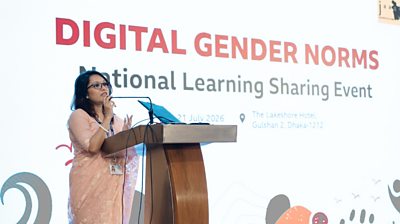
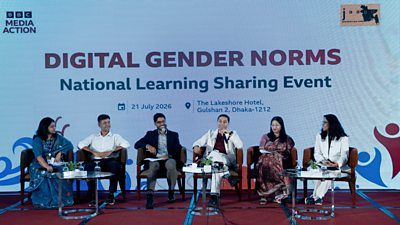
For the last 18 months, Ä¢¹½¶ÌÊÓƵ Media Action has been working with the JAAGO Foundation Trust in Bangladesh’s Savar and Khulna districts to address these norms and help families to understand how to use the internet safely and effectively. In July 2026, we brought together government representatives, development partners, researchers, educators, community members, project participants and media professionals to reflect on what has been achieved and what was learned.
“We, as parents, were always worried about giving mobile phones to our children. But now our perspective has changed. Through the training sessions, my daughter learned how to use the internet positively, stay safe online and develop skills that can help her earn an income,� Habibur said, in sharing his experience.
Habibur and his daughter, a college student, both took part in the project's training in Savar. Since then, they have learned to use the internet safely and confidently. Humaira also completed online coding courses and started earning money using her new skills.
Parents, teachers, adolescent girls and young women have reported that the project improved their digital confidence, encouraged safer online practices and increased their learning and career opportunities.
Country Director of Ä¢¹½¶ÌÊÓƵ Media Action Bangladesh and Asia-Pacific Regional Director, Md. Al Mamun, said that social and family barriers continue to limit many adolescent girls and young women from accessing digital spaces.
“We are going to miss 50 per cent of our human potential if women do not have access to digital spaces. When women are denied access to digital platforms, their voices are also silenced. As a result, their opinions and perspectives remain unheard,� he said.
Our research-based digital gender norms project used innovative approaches to understand the digital attitudes and behaviours of adolescent girls, young women and the people who influence their decisions, and to begin to address them. Our formative research found that gender norms that limit girls' mobility, visibility and relationships offline are increasingly being reinforced in digital spaces. Many family members see monitoring girls' phones, messages, passwords and social media accounts as acts of care and protection. Limited digital literacy among parents and other decision-makers often increases fear, leading to even greater restrictions.
The research also found that these restrictive gender norms are being passed on to the next generation, with many adolescent boys adopting the role of "protector" believing that it’s justified to control girls' online activities.
Our project engaged more than 2,000 individuals including adolescent girls, boys, young men, parents, husbands and brothers through awareness sessions and trainings. The project’s social media campaign featured 53 pieces of content, including mini drama series, podcasts, success stories, vox pops and explainer videos, reaching more than 5.3 million people.
During a panel discussion at our event, State Minister for the Ministry of Primary and Mass Education Bobby Hajjaj said Bangladesh has entered the digital era, but digital literacy has not kept pace. Drawing a comparison, he noted that smartphones today are viewed much like books once were, when parents of an earlier generation treated them as taboos. “Ensuring digital safety is essential. Rather than keeping children away from the internet, we should equip them with the knowledge and skills to use it safely and effectively,� he said. He also emphasised the need for laws and policy in dealing with digital harassment cases.
While sharing his experience, the husband of a young woman from Khulna shared how the project changed his thinking. “Earlier, if a girl had a phone, I would get annoyed. I used to think, why do girls need these things and enter the online world? They will get married and go to their husband's house. But now (after training) I believe girls should have access to the internet because they can learn many useful things from it.�
Our project has shown that lasting change begins by changing attitudes. Its community-centred innovative approach has helped create a more supportive environment where adolescent girls and young women can use digital technology with confidence and purpose. While many more communities still need to be reached, the project has demonstrated that challenging harmful social norms can help build a more inclusive digital future for everyone.
Latest news from Bangladesh
Our projects in Bangladesh
-
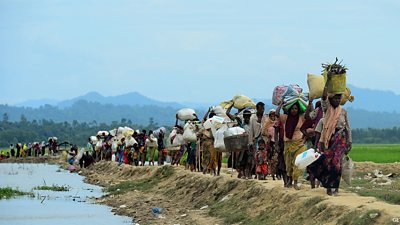
Responding to the Rohingya emergency in Bangladesh
We’re supporting local radio partners to produce a dedicated Lifeline radio programme for Rohingya people and host communities in living in Cox’s Bazar. -
Protecting independent media for effective development
We are working with media support organisations and local partners to find out how best to support public interest media in Sierra Leone, Ethiopia and Bangladesh. -
Hello I Am - challenging child marriage in Bangladesh
Watch our films with Rutgers showing how girls are breaking down barriers, in school and on the cricket pitch. -
Communication to counter the COVID-19 ‘info-demic’
Ä¢¹½¶ÌÊÓƵ Media Action launches new project in Asia to tackle the spread of mis- and dis-information around COVID-19 (coronavirus) which is as harmful as the disease itself. -
Generation Breakthrough: Using radio to encourage healthy relationships in Bangladesh
Engaging a young people with a range of social and health related topics through a weekly radio show radio Dosh Unisher Mor (Crossroads at 10 to 19). -
Preparing for and responding to disasters in Bangladesh
Ä¢¹½¶ÌÊÓƵ Media Action and its partners are helping the public prepare better for future disasters as well as providing timely, accurate and useful information in times of crisis. -
TV drama on maternal and newborn health in Bangladesh
Through a major TV drama series, a radio magazine show, public service announcements and communication skills training for community health workers. -

Debate programme Sanglap
Sanglap (Dialogue), was a political discussion TV show enabling Bangladeshis from all walks of life to question their leaders on the issues that mattered to them.
Search by Tag:
- Tagged with Bangladesh Bangladesh
- Tagged with Asia Asia
- Tagged with Gender Gender